CLICK LINK BELOW

Tuesday, November 22, 2011


Monday, November 21, 2011
Dentistry Interview with Dr. Ken Lee, DVM

Dr. Ken Lee, a DVM practicing at Deer Creek Animal Hospital in Littleton, Colorado, is working towards achieving his official specialty in dentistry. He is a wealth of knowledge regarding animal dental health and disease, and was kind enough to agree to answer some great questions for everyone. This is an important read, please forward to fellow dog lovers!
General Questions:
1. How long have you been a DVM, and what is your attraction to dentistry?
25 years in May 2012. My older brother was actually my dentist when I was growing up. I also got introduced to Dr. Peter Emily a human dentist that was instrumental in building up the importance of good oral health in the veterinary field.
25 years in May 2012. My older brother was actually my dentist when I was growing up. I also got introduced to Dr. Peter Emily a human dentist that was instrumental in building up the importance of good oral health in the veterinary field.
2. Often time people surrender dogs because they could not appropriately anticipate the costs of dog ownership. How much money would you advise people put in their 'rainy day fund' for annual dentistry visits?
For a complete oral exam and cleaning under anesthesia ~ $300-350 depending on the age and the pre-anesthetic blood work required. However, there are some good pet insurance plans that some of our clients have taken advantage of and depending on the coverage elected can include help with maintenance dental care just like for people. More of our clients are purchasing pet insurance when they purchase their new puppy.
How does this differ from younger years into being a senior?
Obviously senior dogs have probably a greater share of dental disease, especially periodontal disease-bone loss around the teeth over time. But the younger dogs, especially the large breeds that like to chew frequently chip their teeth, which can open the porous part of the tooth to infection and cause tooth death.
For a complete oral exam and cleaning under anesthesia ~ $300-350 depending on the age and the pre-anesthetic blood work required. However, there are some good pet insurance plans that some of our clients have taken advantage of and depending on the coverage elected can include help with maintenance dental care just like for people. More of our clients are purchasing pet insurance when they purchase their new puppy.
How does this differ from younger years into being a senior?
Obviously senior dogs have probably a greater share of dental disease, especially periodontal disease-bone loss around the teeth over time. But the younger dogs, especially the large breeds that like to chew frequently chip their teeth, which can open the porous part of the tooth to infection and cause tooth death.
3. What do you say to owners who only anticipate yearly blood work costs, with regard to the importance of dental care and why they should make that expense?
Annual blood work is important because for every year dog's age ~6-7 human years. There are many research studies in human medicine and a handful in the veterinary field that show a direct relationship of lesions developing in the heart, kidneys and liver secondary to periodontal disease, which happens to be the most common disease in dogs. In addition, dental disease can often lead to oral pain yet dogs rarely show signs of pain. They hardly ever stop eating or paw at their mouth. Only after we fix a dental problem that owners then notice an improvement in their dog's attitude.
Annual blood work is important because for every year dog's age ~6-7 human years. There are many research studies in human medicine and a handful in the veterinary field that show a direct relationship of lesions developing in the heart, kidneys and liver secondary to periodontal disease, which happens to be the most common disease in dogs. In addition, dental disease can often lead to oral pain yet dogs rarely show signs of pain. They hardly ever stop eating or paw at their mouth. Only after we fix a dental problem that owners then notice an improvement in their dog's attitude.
4. What are the specific dentistry concerns for Pyr owners, and/or just large breed dog owners in general?
Fractured or chipped teeth and periodontal disease and oral masses as they age.
Fractured or chipped teeth and periodontal disease and oral masses as they age.
5. At what age do we need to start getting dental prophys performed?
At Deer creek animal hospital we recommend the first complete oral exam and cleaning under anesthesia ~ 2-2.5 years for small breeds and ~ 3 years for large breeds.
At Deer creek animal hospital we recommend the first complete oral exam and cleaning under anesthesia ~ 2-2.5 years for small breeds and ~ 3 years for large breeds.
6. My dog chews bark/sticks. Should I be concerned? Although bark and sticks are usually not hard enough to break dogs teeth they can sometimes splinter and poke into the soft tissues in the back of the mouth and cause trauma and infection.
7. What's the real truth about letting your dog chew cooked bones and/or versus raw bones?
All cooked bones are potentially a problem. Chicken and turkey bones because they're hollow can splinter and cause serious damage to the intestinal tract. Beef bones can fracture teeth. There are some raw diets that I've seen work well with no digestive issues or risk to teeth fractures although there is a higher risk of some potentially serious bacterial infections.
All cooked bones are potentially a problem. Chicken and turkey bones because they're hollow can splinter and cause serious damage to the intestinal tract. Beef bones can fracture teeth. There are some raw diets that I've seen work well with no digestive issues or risk to teeth fractures although there is a higher risk of some potentially serious bacterial infections.
8. "I just cannot brush my dog's teeth"... what is my 2nd option?
Sometimes like any dog training issues it can take patience and time. Try offering just a finger in your pets mouth with something they like such as chicken flavored dog tooth paste or cheese and let them lick it off while at the same time moving your finger around in the mouth. Then try a toothbrush doing the same thing. This may take a few weeks or longer in some dogs. The gold standard in home dental care whether in people or dogs is mechanically wiping or brushing the goo (plaque) off the teeth. The goal is to wipe it away before it has a chance to form a hard brown covering called tartar or calculus. If your dog won't accept a brush I've had many clients that have been successful by using gauze wrapped around their finger. There are dental diets and dog appropriate chew toys that abrade and help keep teeth clean as other options.
Sometimes like any dog training issues it can take patience and time. Try offering just a finger in your pets mouth with something they like such as chicken flavored dog tooth paste or cheese and let them lick it off while at the same time moving your finger around in the mouth. Then try a toothbrush doing the same thing. This may take a few weeks or longer in some dogs. The gold standard in home dental care whether in people or dogs is mechanically wiping or brushing the goo (plaque) off the teeth. The goal is to wipe it away before it has a chance to form a hard brown covering called tartar or calculus. If your dog won't accept a brush I've had many clients that have been successful by using gauze wrapped around their finger. There are dental diets and dog appropriate chew toys that abrade and help keep teeth clean as other options.
9. Puppy owners need to be educated about puppy teeth. What 'teething' toys do you recommend? A general rule I give puppy and dog owners is if you can't break it or bend it or indent your nail into it, it's too hard to give. There is a website www.vohc.org that has appropriate dental chew toys listed that are relatively safe that have been tested by veterinary dental specialists. Also I feel good about the dental chews we have at Deer creek.
10. Ideally I'd brush my dog's teeth every day. Most owners aren't going to do this. What is the least amount of recommended brushing?
Studies have shown that you need to try to do it at least 3 times a week to make a significant difference in preventing tartar build up.
Studies have shown that you need to try to do it at least 3 times a week to make a significant difference in preventing tartar build up.
11. "My dog has a tooth that looks "dead". It's dark and discolored. Should I be concerned if it doesn't seem to be bothering him?"
Dark teeth are a sign typically of a dead tooth with the potential of causing pain. The Hale study in 2001 showed ~92% of these teeth to be dead. Unfortunately, dogs rarely show signs of dental pain that I addressed in question #3.
Dark teeth are a sign typically of a dead tooth with the potential of causing pain. The Hale study in 2001 showed ~92% of these teeth to be dead. Unfortunately, dogs rarely show signs of dental pain that I addressed in question #3.
12. My dog has bad breath. Can he have bad breath without having disease present?
Bad breath is the most common sign that dog owners notice and usually means significant dental disease or at least a trip in to your veterinarian to have it evaluated. Sometimes serious infections in the kidneys or liver can cause bad breath too.
Bad breath is the most common sign that dog owners notice and usually means significant dental disease or at least a trip in to your veterinarian to have it evaluated. Sometimes serious infections in the kidneys or liver can cause bad breath too.
Questions from Vicky, Boxer owner:
- Many of those who feed a raw diet claim that this negates the need for dental care, as the teeth gain a thorough cleaning via the biting through soft bone and gnawing on the harder bones. Have you seen this to be true? I have seen some positive results in dogs being fed this diet. However, dogs fed these diets can still develop periodontal disease under the gum line and fracture teeth that can cause them pain. A complete annual exam by a veterinarian can catch some of these problems, however since our furry friends don't communicate pain to us well a complete oral exam under anesthesia with dental x-rays is the only way to thoroughly evaluate for these dental problems.
- Many treats (flossies, rawhides, cookies) and flavored bones of various types are sold in pet stores and claim to be good for dental health. How much of this is true? Some of them are good, some are not. I refer you to Q#9.
- What are the dental implications between feeding dry kibble vs. canned? Studies have shown that feeding strictly dry food diets compared to canned food can decrease tartar accumulation by about a 1/3.
1. What's the best for cleaning a dog's teeth; nylabone, rawhide, greenies, real bones? Nylabones and real bones can break teeth. I refer you to the website www.vohc.org -appropriate chew toys
2. My vet's office always tries to get me to buy a liquid to put in my dog's water that is supposed to help keep their teeth clean. What is it? Being a dental hygienist I just don't believe there is a product that will really keep tartar from building up. And if it is really does work why is it not safe for humans? I'm an over protective dog mommy and I don't want to give my baby something that isn't safe for humans to consume.
Yes, there are many products out there that are marketed as drinking water additives. Some contain chlorhexidine and/or zinc gluconate which are very good oral cleansing solutions for people and do a good job for cleansing solutions for dogs as well. I personally have not seen any real health issues from these drinking additives in dogs. Probably because they are so diluted ~ 1-2 TSP in a qt of water it doesn't cause a problem. So these products could potentially help with decreasing some bad breath but I have not seen any control studies that have shown a decrease in tartar and gingivitis. I always tell my clients there are only three things our dentists or dental hygienist gives us at our dental appointments. A toothbrush, toothpaste and dental floss. Dog teeth anatomy has significant enough space between them that floss is not needed, thank goodness. Again, mechanical brushing or wiping is the gold standard in preventative dental care in dogs and people.
Yes, there are many products out there that are marketed as drinking water additives. Some contain chlorhexidine and/or zinc gluconate which are very good oral cleansing solutions for people and do a good job for cleansing solutions for dogs as well. I personally have not seen any real health issues from these drinking additives in dogs. Probably because they are so diluted ~ 1-2 TSP in a qt of water it doesn't cause a problem. So these products could potentially help with decreasing some bad breath but I have not seen any control studies that have shown a decrease in tartar and gingivitis. I always tell my clients there are only three things our dentists or dental hygienist gives us at our dental appointments. A toothbrush, toothpaste and dental floss. Dog teeth anatomy has significant enough space between them that floss is not needed, thank goodness. Again, mechanical brushing or wiping is the gold standard in preventative dental care in dogs and people.
3. Also being a hygienist a lot of people ask for my old tools to clean their dogs teeth with. We always tell them no. They can do a lot of damage to the dog's gums, gouge the root surfaces, the dog could bite them or they could slip and the sharp instrument could go anywhere, and most of all they can't sterilize the instruments! Is there any safe way to chip away at a dog's teeth at home?
I agree with all you mentioned. These tools can cause micro-scratches in the enamel of the tooth and the roughen surface and can increase the tartar accumulation even faster. They also aren't addressing what's under the gum line, which contains the majority of the oral infection.
I agree with all you mentioned. These tools can cause micro-scratches in the enamel of the tooth and the roughen surface and can increase the tartar accumulation even faster. They also aren't addressing what's under the gum line, which contains the majority of the oral infection.
4. In dentistry we insist on putting a crown on teeth that have had a root canal. The tooth gets dry and brittle and is highly likely to break off at the gum line in the future. Is it recommended that we crown our dogs teeth post RCT as well? They chew much harder things than we do. Are they at risk?
Yes to all of the above but I think client education on appropriate chew tows and addressing behavior problems is more important. Crowns can help protect a tooth from further trauma post root canal therapy and we do place them for that reason at Deer creek. However, I also have seen teeth broken with the crown still attached to them so a crown is no guarantee, especially with the increase bite power dogs can elicit with their jaw angle.
Yes to all of the above but I think client education on appropriate chew tows and addressing behavior problems is more important. Crowns can help protect a tooth from further trauma post root canal therapy and we do place them for that reason at Deer creek. However, I also have seen teeth broken with the crown still attached to them so a crown is no guarantee, especially with the increase bite power dogs can elicit with their jaw angle.
5. Angus is a big time poop eater. What impact does that have on his mouth?
Other than the obvious nothing much different than feeding canned food.
Other than the obvious nothing much different than feeding canned food.
6. And just a random thing I've always wondered. It seems like lapping water is so ineffective. Should I add water to the dog food to make sure he is hydrated well enough?
I have not seen problems with dogs hydrating themselves with their normal drinking activities.
I have not seen problems with dogs hydrating themselves with their normal drinking activities.
Final Question:
If you could give 1 piece of advice to all dog and cat owners regarding dental health, what would it be? Prevention just like in people. Annual oral exams and cleanings starting at 2-3 years of age and consistent home care. Our pets will benefit with longer, higher quality lifespans.
If you could give 1 piece of advice to all dog and cat owners regarding dental health, what would it be? Prevention just like in people. Annual oral exams and cleanings starting at 2-3 years of age and consistent home care. Our pets will benefit with longer, higher quality lifespans.
by Shannon Murphy
Saturday, November 19, 2011
Meet Kenya!
ADOPTED!!
Kenya

Everyone, meet Kenya! This sweet boy has had quite a rough time. Kenya first came to CGPR last April (2010) and was very shy and fearful. It seemed as though he had been through a lot, but we weren't sure what. He went to a foster home who had him for 7 months; they told us that they planned to adopt him so we waited for their contract to come through. They officially adopted Kenya in March of this year (2011) signing a contract stating that they would call us if anything ever came up where he needed to be returned. Well, last night they dumped the poor guy at the shelter because he is too nervous in their home. Ken went and picked him up this morning so that he wouldn't be euthanized. As you all know, our rescue has been dissolved, so we are looking for a home for this sweet baby.
Kenya's Ideal Home:
Kenya would do best in a calm environment without children. He needs someone that understands that something bad happened to him in his past (although we don't know what) and be willing to work with him on understanding that the world is a good place. Kenya just wants someone to love him forever and not dump him at a shelter when he gets scared. Kenya is about 3 years old and does well with both cats and dogs.
Animal Rescue of the Rockies graciously accepted Kenya into their rescue! Click Here to see his profile and learn about their adoption process!
BEFORE You Adopt A Great Pyrenees

I have read that a nickname for Great Pyrenees is "Disa-pyr". While there are several breed traits to make yourself aware of, we have found over time that a very common theme in owner surrenders of these angelic dogs is the owner saying they "can't keep" the dog in the yard, or that it keeps running away. We have had several owners lose their tolerance for their "escape artist" and surrender. While breed traits are explained to potential owners, AND it's a new owner's responsibility to educate themselves, this breed trait does not seem to be taken into consideration appropriately.
As with anything, there are always exceptions to the rule, but you need to anticipate the breed standard, and if your dog is different in a way you perceive to be "different" than the standard, than you are fortunate. Also, never assume that your newly adopted dog, if it's older, will behave the same way it behaved for a previous owner. In new environments, dogs can manifest new behaviors due to new stimuli. Not all new potential behaviors may be bad; however, a Pyr prone to night barking may bark more in your home than in a previous one due to your neighborhood's stimulation.
The trait people need to really and truly understand is the breed's natural tendency to wander. You tell potential owners that they cannot be off-leash dogs, and they perhaps still think their dog will be different. Pyrs typically do best with a privacy fence, yet owners will have short, wire fences and their Pyrs will escape. When testing your dog's personal boundaries and behaviors against it's natural breed inclination do so in a guarded environment where you will be able to see how they fare.
If you want an off-leash dog, a dog to leave in the back yard unattended without a 6-foot privacy fence, please think twice about adopting a Pyr. If you want those things and want a Pyr regardless, you need to have plans in place to see how they really will fare in those environments.
All the same, understand the Pyr for the breed they are and accept that lifestyle for them. Great Pyrenees are naturally inclined to "go away". Meaning, regardless of how you raise them, it's in their DNA to be livestock guardians. Pyrs were bred to be independent from people, to stay in the hills with their sheep and guard them. Everything the Pyr could see was his cause to be concerned. We often say, "a Pyr thinks everything they see is theirs to guard". Your Pyr needs to know if there is a coyote over that hill threatening his flock, so he will go there, to ensure that threat isn't present.
An off-leash Pyr will think nothing of leaving you in the dust. They will also be surprised you are annoyed at them for this. They think they are checking out the perimeter around you to ensure no predators are present. Likewise with fences, if they think they see something they need to check out, they will be gone. They are not out romping for fun. Imagine your Pyr having a 5-foot wire fence they can clearly see through; if they see another dog, a coyote, a suspicious person, they will do their best to "do their job", scale that fence, and go secure their flock. Maybe you had them fenced like this for a year and "it never happened". Consider they probably never had the proper stimulation…yet.
One of my Pyrs seems as if she'd stay with me if I let her off leash. Though I never care to test her on this, because I can't anticipate the potential for stimulation that I cannot control, I would never test her in an environment where I could lose her. I'd take her to a dog park on a day with only a couple of other dogs present, and see how she fares staying by my side to my command. Pyrs aren't exactly good at obeying commands, for all the reasons they were bred to be independent from people to perform their job.
I have a 6 foot privacy fence, and that same Pyr lounges under the deck most times she's outside, and never shows an interest at its perimeter. Nonetheless, I know she's a Pyr. I make sure my perimeter has no dug out holes she could escape through if she sensed a threat. Standing on our deck, my other Pyr can easily see beyond that fence. Garbage men, cars, homeless people…if he sees them, he goes nuts. If he could scale that fence, he would…and he'd be gone.
Dawn would get calls from panicked owners about how they came home, having left their Pyr out while they were gone, and came home to no Pyr. While of course you go and look for them, she'd always tell them she felt if they didn't find them, they'd come home after hours of looking to their Pyr sitting on their doorstep. Pyrs would return home to their "farm" after making sure that "wolf" wasn't there, but they sure as heck are going to do their job first.
If you are NOT absolutely committed to an on-leash dog, or a tall privacy fence when they go out to potty and play, please think hard before adopting this breed. If you want to leave your dog outside while you are gone, please reconsider this dog, and pretty much any dog. Unless your dog is a working dog on your farm, let them be part of the family and live inside when you are gone. Too many Pyrs have been surrendered who were tethered up outside because their owner felt that was the only way to "keep them" from running away. Just think hard on your dog breed match, and never think you can out-train a long history of breeding this INTO the dog. Those who own Pyrs to work as livestock guardians can attest, all this independence is what allows the owners to sleep at night, knowing their flocks are protected without the direction of a human…it's natural for them!
-by Shannon Murphy
Great Pyrenees Breed Quiz!
More About the Breed
[we have found this internet description to be one of the most accurate out there]
More About the Breed
[we have found this internet description to be one of the most accurate out there]
A Pyr in Alabama Needs Your Help
If anyone can help this beautiful girl, the shelter info is below.
If pull help is needed, Emily and Kitty with Southbark might be able to help. Their emails are:
If pull help is needed, Emily and Kitty with Southbark might be able to help. Their emails are:
Emily Reynolds: emilyrreynolds@yahoo.com (yahoo.com)
Kitty Tripp: kittymarimba@gmail.com (gmail.com)
Thank you!
ID#A041053
I am a female, white Great Pyrenees.
The shelter staff think I am about 2 years old.
I have been at the shelter since Nov 15, 2011.
This information is less than 1 hour old.
I am a female, white Great Pyrenees.
The shelter staff think I am about 2 years old.
I have been at the shelter since Nov 15, 2011.
This information is less than 1 hour old.
For more information about this animal, call:
Mobile County Animal Shelter at (251) 574-3230
Ask for information about animal ID number A041053
Mobile County Animal Shelter at (251) 574-3230
Ask for information about animal ID number A041053
Mobile County Animal Shelter
|
|
|
7665 Howells Ferry Road
|
Mobile, AL 36608
|
Pyrs In Need In Ilinois
We were just made aware of two Pyrenees in Illinois who need adoption, rescue, or foster. Please see below, and forward this to anyone you know who lives in that state! All adoption information below is through the organization who has them currently.

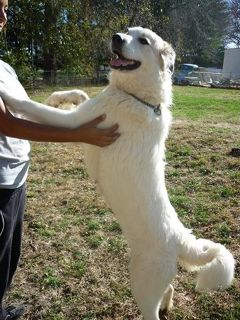


Hayden-- 1 yr. old-- 95 lbs-- White Great Pyrenees (shorter hair)
-owner surrender (moving)
-great with people
-good with other dogs
-$100 includes ALL vetting
Annie--2yr. 6 months--60 lbs-- Longhair White Great Pyrenees
-owner surrender (moving)
-great with people
-good with other dogs
-$100 includes ALL vetting
Please email Anne.Heckle@att.net ASAP if you can rescue them - owner surrenders can be PTS immediately due to space.
Subscribe to:
Posts (Atom)